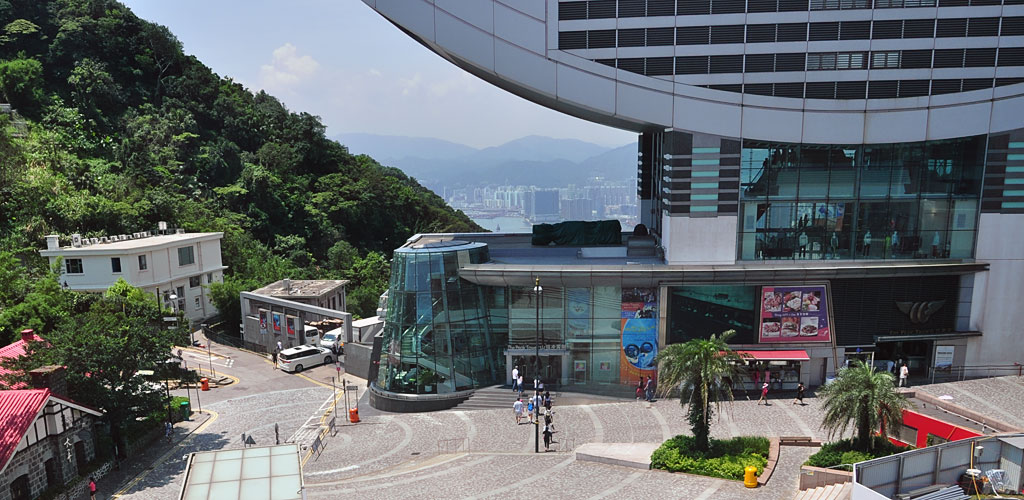
Will You Actually See the View? Fog, Mist and Visibility at Victoria Peak
Victoria Peak stands in sea-level weather and then climbs above it: the main public viewing deck, Sky Terrace 428, sits at 428 m, so on plenty of days the viewpoints are wrapped in low cloud while the streets of Central, a few minutes below, are bright and clear. The question worth answering before you set off is therefore not "what is the weather like in Hong Kong today?" but "is the summit itself clear right now?" — and that is a question you can answer in about a minute, using the official tools below.
When fog actually happens at the Peak
Fog is a real but limited part of the Peak year. In the Hong Kong Observatory's 1991–2020 climate normals, the Observatory records an average of 3.70 days a year with fog — fog being defined as visibility below 1,000 m — and those days are heavily concentrated in spring. February (1.10 days) and March (1.47 days) together account for about 69.5% of the year's fog days (2.57 of 3.70). June through November record no fog days at all.
| Month | Mean fog days (visibility < 1,000 m) | Mean cloud amount | Bright sunshine (% of possible) |
|---|---|---|---|
| January | 0.20 | 62% | 43% |
| February | 1.10 | 72% | 32% |
| March | 1.47 | 77% | 27% |
| April | 0.83 | 77% | 30% |
| May | 0.07 | 76% | 34% |
| June | – | 77% | 36% |
| July | – | 72% | 48% |
| August | – | 70% | 46% |
| September | – | 66% | 47% |
| October | – | 58% | 55% |
| November | – | 58% | 52% |
| December | 0.03 | 57% | 48% |
| Year | 3.70 | 68% | 41% |
Source: Hong Kong Observatory, Monthly Meteorological Normals for Hong Kong 1991–2020. Fog days, cloud amount and sunshine are recorded at the Observatory and King's Park and describe Hong Kong as a whole; the Peak, several hundred metres higher, can sit in cloud on days when the city below stays clear — which is exactly why the live check below matters.
Two things follow. Spring (February–March) is when the Peak most often disappears into mist — the operator's own seasonal page describes March as the month when "the landscape is gently enveloped in a thin fog". And the clearest window is the back end of the year: October to December carry the year's lowest cloud cover (58%, 58%, 57%), its highest bright sunshine (55% in October, the sunniest month of all) and effectively no fog. If the view itself is the priority, aim for that window and treat February and March as the months to check before you commit. For the month-by-month feel of each season — temperatures, rain and what to pack — see our Weather on Victoria Peak guide and the best time to visit Victoria Peak.
Check before you go — the 60-second version
You do not have to guess. The Peak's operator itself directs visitors to the Hong Kong Observatory's live Peak cameras, and there are two:
- Victoria Peak, looking east — HKO weather photo VPA. This is the frame closest to the classic harbour-and-skyline view.
- Victoria Peak automatic weather station, looking north-north-east — HKO weather photo VPB.
A new picture is taken every five minutes, and each page carries an animation of the past six hours. What to look for is simple: in the east-facing frame, can you pick out the opposite shoreline and the tower cluster across Victoria Harbour? If the image is an unbroken grey wall, the summit is inside cloud. If the towers are sharp, the view is there. Watching the six-hour animation is the quickest way to tell whether a misty morning is lifting or settling in.
For a number rather than a picture, the Observatory's regional weather readings include a "10-Minute Mean Visibility" for stations such as Central, Chek Lap Kok, Sai Wan Ho and Waglan Island, given in kilometres. The higher the figure, the clearer the air; a low figure at Central usually means the Peak above it is no better off.
As a rough guide, some third-party travel guides use the rule of thumb that once the cloud base drops below roughly 400 m, a terrace at 428 m such as Sky Terrace 428 is sitting inside the cloud. Treat that as an unofficial estimate rather than an official reading — the webcams and the Observatory's own numbers are what should decide the trip.
When the Peak is socked in
A blank view does not have to mean a wasted day. The Peak is a hill with a small village on top, not only a panorama:
- The Circle Walk (Lugard Road) — the 3.5 km loop around the summit is a genuinely good walk in mist, through dripping subtropical forest, and it is free and open at all hours.
- The Peak Tower's indoor floors — shops, cafes and restaurants sit directly under the terrace; the summit complex keeps trading on overcast days.
- Madame Tussauds Hong Kong — an indoor attraction that does not depend on the weather at all.
- Free public viewpoints and the walk — worth knowing that the operator is explicit that "the quality of the view cannot be guaranteed under certain circumstances such as adverse weather". On a no-visibility day, do not buy a paid panorama-deck ticket for a view you cannot get; the public viewpoints and the walk cost nothing.

A misty hillside on Victoria Peak — illustrative photograph, not a picture of any specific day. Photo: hk-victoria-peak.com
What does not close for fog
Fog alone is not a closure trigger. The operator's published weather arrangements keep the Peak Tram, the Peak Tower and Sky Terrace 428 open under an Amber or Red Rainstorm Warning and under Typhoon Signal No. 1 or No. 3; it is a Black Rainstorm Warning or Typhoon Signal No. 8 or above that closes them. Fog and mist do not appear on that list. So on a misty day the question is not whether the Peak will be operating — it will be — but whether the view will be visible. Run the 60-second check above.
For the closures that do happen, see the operator's Arrangements for Inclement Weather Conditions.
Frequently asked questions
Is Victoria Peak worth it on a foggy day?
If the view is the only reason you are going, a fogged-in day will disappoint — and the operator makes clear that no view is guaranteed. But the Circle Walk, the Peak Tower's indoor floors, dining and the wax museum still make a good half-day, and spring mist often burns off by midday (see the weather guide). Check the webcam first, then decide from the picture.
What time of day does mist clear?
Spring mist at the Peak is typically an early-morning feature — our weather guide notes that on spring days you may not see the far end of the street at 6 am yet have crisp blue sky by noon. Use the webcams' six-hour animation to judge the direction of travel before you commit to the trip up.
Which months are clearest?
October to December. Cloud cover is lowest (58%, 58% and 57%), bright sunshine is highest (55% in October) and the Observatory records almost no fog. February and March are the foggiest: between them they hold about seven of every ten fog days in the year.
Can I see anything at night in fog?
Usually, yes — the harbour's lights are what most night visitors come for, and an overcast sky does not normally dim the night skyline; the low fog that blots the Peak is mostly a morning phenomenon. Our weather guide sums up the night view as the least weather-dependent on the Peak.
Before any viewpoint trip it is worth running the same check: our complete guide to the best viewpoints on Victoria Peak covers what to see and where, and it is only ever as good as the day's visibility.