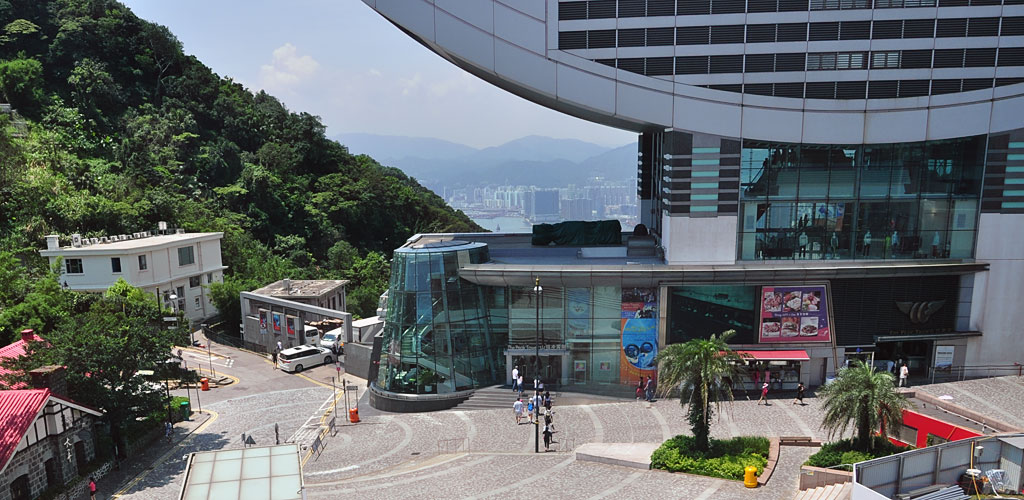
Victoria Peak in a Typhoon — What Closes, and When It Reopens
Home > Weather > Typhoon and severe weather at the Peak
When a warning is hoisted, the only question that matters is whether the Peak Tram is still running and whether the paid terrace is worth buying. The short answer: most warnings change nothing. Under an Amber or Red Rainstorm Warning, and under Typhoon Signal No. 1 or No. 3, the Peak Tram, the Peak Tower and Sky Terrace 428 all stay open exactly as normal. What actually stops the Peak is a Black Rainstorm Warning or Typhoon Signal No. 8 or above — and the time of day the warning is hoisted decides whether the day is finished or just interrupted. The table below is the operator's own published policy, row by row.
The signal-by-signal policy
| Warning in force | What is open | When it reopens |
|---|---|---|
| Amber or Red Rainstorm Warning; Typhoon Signal No. 1 or No. 3 | Everything — the Peak Tram, the Peak Tower and Sky Terrace 428 all remain open. | No interruption. Normal hours. |
| Black Rainstorm Warning — hoisted before opening hours | Nothing. The Peak Tram, the Peak Tower and Sky Terrace 428 remain closed. | They reopen once the warning is lowered. |
| Black Rainstorm Warning — hoisted during the day | The Peak Tram stays open with limited operations and the Peak Tower stays open. Sky Terrace 428 closes immediately. | If the warning is cancelled or lowered at or before 6 pm, Sky Terrace 428 aims to resume about three hours later. |
| Typhoon Signal No. 8 or above — hoisted before opening hours | Nothing. The Peak Tram, the Peak Tower and Sky Terrace 428 remain closed. | They reopen once the signal is lowered. |
| Typhoon Signal No. 8 or above — hoisted during the day | The Peak Tram is suspended within about an hour. Sky Terrace 428 closes immediately, and guests already on site are guided and supported by staff to safety. | Cancelled or lowered at or before 6 pm: the tram, tower and terrace aim to resume about three hours later. Cancelled or lowered after 6 pm: all three remain closed for the rest of the day. |
Source: the operator's Arrangements for Inclement Weather Conditions (thepeak.com.hk), read October 2026. Signal levels are quoted as the operator and the Hong Kong Observatory name them: Typhoon Signal No. 1, No. 3 and No. 8; Amber, Red and Black Rainstorm Warnings. The operator adds that implementation of the arrangements is subject to the actual circumstances.
The one-line version. Amber or Red Rainstorm Warning, or Typhoon Signal No. 1 or No. 3 → the Peak runs as normal. Black Rainstorm Warning or Typhoon Signal No. 8 or above → Sky Terrace 428 closes at once, and Signal 8 also stops the tram within about an hour. On a black rainstorm the tram and tower may keep going in a limited way, but the outdoor terrace is shut.
The 6 pm rule — does the day end or just pause?
Every resume decision turns on one clock time: 6 pm. When a Black Rainstorm Warning or a Typhoon Signal No. 8 or above is cancelled or lowered at or before 6 pm, the operator aims to bring the affected services back about three hours later. So a Signal 8 that is dropped at 4 pm points to a resumption around 7 pm.
If the warning is cancelled or lowered after 6 pm, there is no evening reopening: the Peak Tram, the Peak Tower and Sky Terrace 428 remain closed for the rest of that day. The practical consequence is simple — a storm that clears in the afternoon can still give you an evening on the Peak, but a storm that clears at dusk means the Peak is done until tomorrow.
Two caveats sit on top of the rule. The operator's policy says the arrangements are subject to actual circumstances, so a "three hours later" resumption is the aim rather than a promise. And only Sky Terrace 428 carries the "three hours" resume wording in the black-rainstorm row; for a black rainstorm, the tram and tower are described as staying open with limited operations rather than closing outright.
How likely is this in your month?
Hong Kong's storm season is real but concentrated. In the Observatory's 1991–2020 climate normals, a Typhoon Signal No. 8 or above is hoisted on an average of 2.43 days a year, and signals of No. 1 or above on about 15.87 days a year. The Signal 8+ days cluster tightly into late summer and early autumn: June 0.27, July 0.53, August 0.80, September 0.67 and October 0.13. Between them, June to September account for about 93% of the year's Signal 8+ days (2.27 of 2.43), with August the single likeliest month.
| Month | Mean days, Signal No. 8 or above |
|---|---|
| June | 0.27 |
| July | 0.53 |
| August | 0.80 |
| September | 0.67 |
| October | 0.13 |
| Year | 2.43 |
Source: Hong Kong Observatory, Monthly Meteorological Normals for Hong Kong 1991–2020. These are long-run averages, not a forecast; any given year can bring more or fewer storms. The June–September share is calculated from the same table.
Translated into a trip: if you are visiting in August, there is a modest but genuine chance a warning interrupts one day of your stay; in the cooler months the odds are close to zero. Because the season is short and the disruption narrow — usually a single day, sometimes an evening — the sensible plan is not to avoid the Peak in summer but to keep a flexible day in reserve. See the best time to visit Victoria Peak for how the seasons compare.
How to check, on the day
Warnings are announced by the Hong Kong Observatory, whose live warning page is the authoritative source for whether a signal is in force right now — do not rely on a cached bulletin or a previous day's headline. Hong Kong also issues an Amber, Red or Black Rainstorm Warning on its own, independent of typhoon signals, so both lists are worth a glance.
For the Peak itself, the operator publishes its own service notices on the Peak Tram website; that is the place to confirm whether trams are running and whether Sky Terrace 428 is open before you travel to Garden Road. Buying or holding a paid ticket does not buy a guaranteed ride — the operator's terms allow the Peak Tram or Sky Terrace 428 to be suspended for inclement weather, repair or other reasons with or without prior notice.
If your concern is the view rather than closures, the Observatory runs two live cameras at the summit — one looking east and one looking north-north-east — plus live visibility readings for nearby stations. The operator is explicit that "the quality of the view cannot be guaranteed under certain circumstances such as adverse weather", so a quick look at the camera is the fastest way to judge whether the Peak is clear before you commit. See weather on Victoria Peak for how mist and cloud fit into the year.
Plan B on a storm day
If a Signal 8 or a Black Rainstorm Warning is up, the honest advice is not to queue outdoors at Garden Road for a tram that is likely to stop. What still works:
- The Peak Tower's indoor floors. Shops, cafes and restaurants sit directly under the terrace and keep trading on overcast days, so the summit complex is still a destination even when the panorama is gone.
- Move the Peak visit to the next clear day. The warning itself is the signal that the day is over; the best-time guide is a good way to pick the replacement day.
- Treat the terrace as weather-dependent. Sky Terrace 428 is outdoors at 428 m and is the first thing to close; on a storm day, budget for it being shut and do not buy a combo ticket expecting to use the deck that afternoon.
- If you are already on site when a Signal 8 is hoisted, follow staff. The operator states that guests already present are guided and supported by staff to safety. Do not head for viewpoints or the open hillside as the wind rises.
One practical note for families: the Peak Tram requires baby strollers to be folded before boarding and to be no wider than 66 cm (26 inches) once folded, and staff can help; on a storm day the folding-and-queueing problem is one more reason to sit it out. Visitors who need step-free access can find the Peak Tram's accessibility arrangements through the operator's FAQ.
Rain sweeping over Hong Kong Island — illustrative photograph, not a picture of any named storm. Photo: hk-victoria-peak.com
Frequently asked questions
Does the Peak Tram run in a typhoon?
It depends on the signal. Under Typhoon Signal No. 1 or No. 3 the Peak Tram runs normally. Under Typhoon Signal No. 8 or above, the tram is suspended within about an hour if the signal is hoisted while it is running, or stays closed all day if the signal is already up before the tram starts.
Is Sky Terrace 428 open in a Black Rainstorm Warning?
No. Sky Terrace 428 closes immediately when a Black Rainstorm Warning is hoisted during operating hours. If the warning is up before the day's opening, the terrace stays closed until the warning is lowered, and it aims to resume about three hours after a cancellation at or before 6 pm.
When does the Peak Tram restart after Signal No. 8?
If the signal is cancelled or lowered at or before 6 pm, the Peak Tram, the Peak Tower and Sky Terrace 428 aim to resume about three hours later. If it is cancelled after 6 pm, they remain closed for the rest of the day.
Are buses and minibuses still running in a typhoon?
The operator's published policy covers the Peak Tram, the Peak Tower and Sky Terrace 428 only. Road-based services to the Peak — such as Citybus 15 and green minibus 1 — are run by separate companies under their own arrangements, so check the bus operator's service status rather than assuming the tram's rule applies to them.
Will I still get the view in bad weather?
Not necessarily. The operator does not guarantee the view in adverse weather, and the summit is often inside cloud when lower Hong Kong is clear. Check the Observatory's live Peak cameras before you travel, and see weather on Victoria Peak for what to do when the summit is in cloud.
Should I buy a ticket in advance if a storm is forecast?
Buying ahead does not guarantee that the tram or terrace will be open: the operator may suspend either at short notice for inclement weather. If your trip coincides with a warning, buy on the day once a service notice confirms the trams are running, or keep your plans flexible.
Related guides
Weather month by month: Weather on Victoria Peak. When to plan the trip: the best time to visit Victoria Peak. Whether the view will actually be there: the best viewpoints on Victoria Peak. Tram fares, hours and queues: the Peak Tram ultimate guide. Getting up by road instead: MTR and public transport to the Peak. The operator's own policy, in case it has changed since this page was written: Arrangements for Inclement Weather Conditions.